How to Elope in the Dolomites: The Complete 2026 Guide
PUBLISHED JUNE 18, 2026 · UPDATED AUGUST 20, 2026
The short answer
Most couples elope in the Dolomites with a symbolic ceremony, signing legal paperwork at home, because legal Italian civil marriage requires a Nulla Osta, translated documents and a town-hall ceremony. The mountains themselves are easy: cable cars reach Seceda and Alpe di Siusi, the Tre Cime toll road needs a reservation, and mid June to mid October is the season, with larch gold in late October.
Symbolic or legal: the Italian question first
Italy asks more of foreign couples than almost anywhere else we work. A legal civil marriage requires a Nulla Osta, a certificate of no impediment issued by your consulate or home authority, often alongside sworn statements, apostilles and certified Italian translations. US citizens face an extra step, an Atto Notorio sworn before witnesses. The ceremony itself is then performed by a civil official in a town hall or a municipally approved venue, not on a ridgeline of your choosing. Some towns, including Cortina d'Ampezzo, do offer approved outdoor civil sites, but availability is thin and the paperwork timeline runs months.
So nearly all of our Dolomites couples take the symbolic route: a five-minute legal signing at their local courthouse before or after the trip, then the real ceremony, vows, rings and a celebrant if they want one, at 2,300 metres. Nothing about the day looks or feels different, there are zero location restrictions, and your anniversary is whichever date you choose. If the legally-married-in-Italy certificate genuinely matters to you, we will say so honestly and connect you with a bilingual planner who handles the comune paperwork.
The big four locations and how access actually works
The Dolomites are Europe's most photogenic mountains and one of its easiest alpine logistics puzzles, but every famous viewpoint has a toll road, a cable car schedule or a parking reservation attached. This is what planning here really means.
| Location | Access | What to know for 2026 |
|---|---|---|
| Tre Cime di Lavaredo | Toll road to Rifugio Auronzo, then mostly flat trails | Online reservation now mandatory, around 40 euros per car; road open roughly late May to late October |
| Seceda | Cable car from Ortisei, 10 minutes' walk from the top station | Lifts run daytime hours only, so sunrise or sunset means hiking with headlamps or a rifugio overnight |
| Alpe di Siusi | Cable car from Ortisei or restricted access road | The road closes to private cars in the daytime; we plan early entries for dawn mist in the meadows |
| Lago di Braies | Valley road to lakeside parking | From July to mid September the road is restricted roughly 9 a.m. to 4 p.m. without a booked permit; before 9 a.m. is open, which suits us fine |
Beyond the famous four
Passo Giau, a 2,236-metre pass south of Cortina, is our first choice for sunset ceremonies: park at the top, walk five minutes, and the Ra Gusela tooth and 360-degree light show do the rest. It is also the backbone of winter elopements here, since the pass road is maintained when lifts and high trails are closed.
Cadini di Misurina, the wall of jagged spires that looks painted, sits a short but exposed ridge walk off the Tre Cime road. It became famous fast, so we time it carefully and save it for couples comfortable on a narrow trail. And underneath everything run the valleys: the Val Gardena and Cortina supply vendors, hotels and espresso, all within thirty minutes of the peaks.
The rifugio dinner is the reception
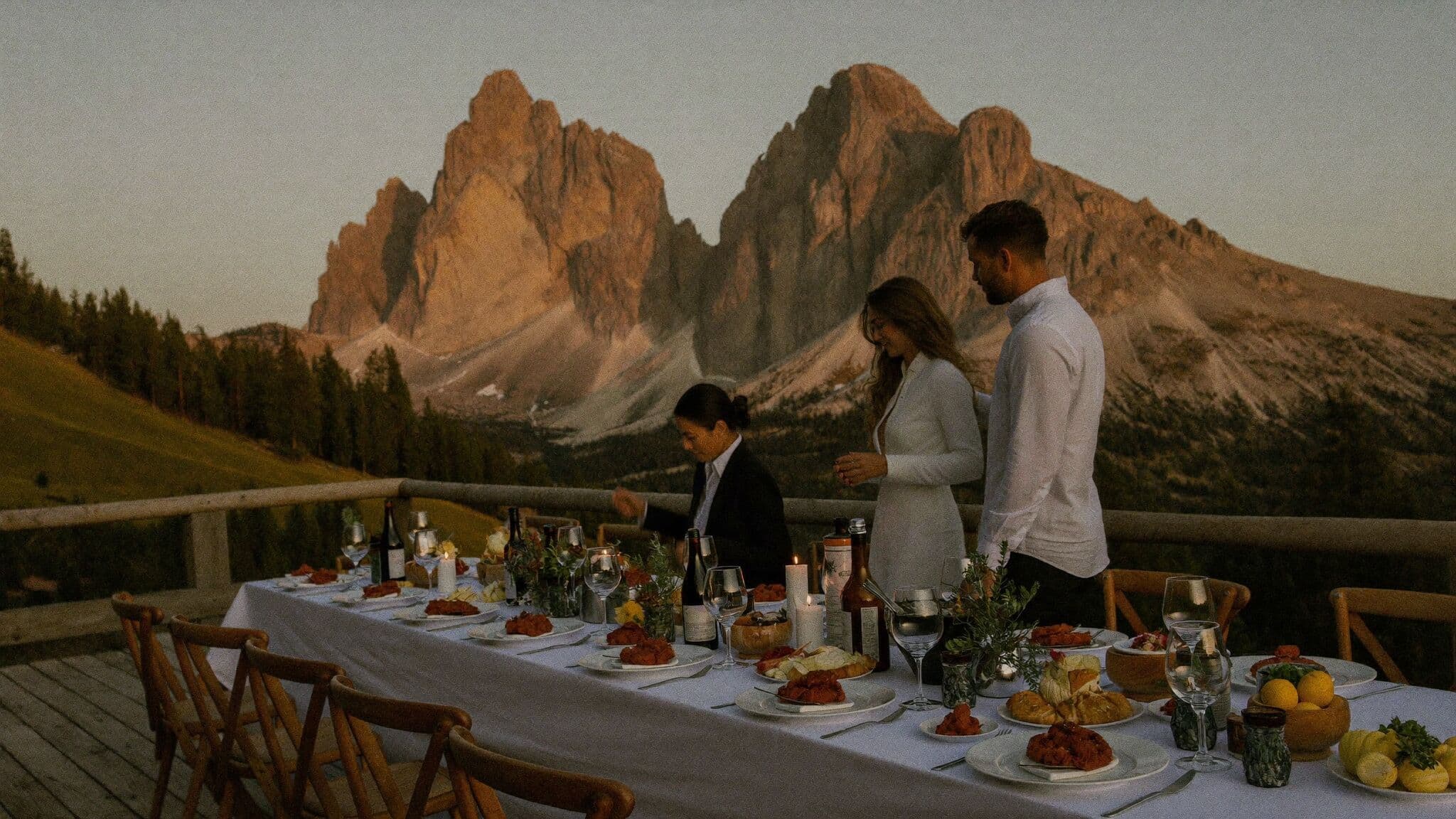
The single most Dolomites thing you can do after a ceremony is walk into a mountain hut and sit down to dinner. Rifugi here serve proper northern Italian food, speck dumplings, handmade pasta, local wine, at full altitude with the peaks going pink outside the window, an effect locals call enrosadira. A post-ceremony rifugio dinner replaces the reception hall entirely, and an overnight means waking above a cloud sea for second-day portraits before the cable cars even open.
We book the rifugio as part of planning, because the good ones fill months ahead in September and October, and several begin closing for the season in mid October.
When to go, and the larch event
The core season runs mid June to mid October. High summer brings green meadows, full lift schedules and afternoon thunderstorms that we plan sunrise starts around. September into early October is the stable, quiet window, our default recommendation.
Then comes larch season. For roughly three weeks from mid to late October the larch forests below the peaks turn deep gold, the best autumn show in the Alps, with most tourists already gone. The trade-off is that some lifts and rifugi have closed by then, so larch-season plans lean on road-accessed locations like Passo Giau and the Tre Cime area. It is absolutely worth building a whole trip around, and every year a handful of our couples do.
A sample Dolomites elopement day
- 04:45 – Drive from the Val Gardena; hair and makeup done the night before, touch-ups en route
- 06:00 – First light at Lago di Braies, in before the access restrictions and the crowds
- 09:30 – Rest and second breakfast in a valley café
- 13:00 – Cable car up to Seceda, twenty easy minutes to the ridgeline
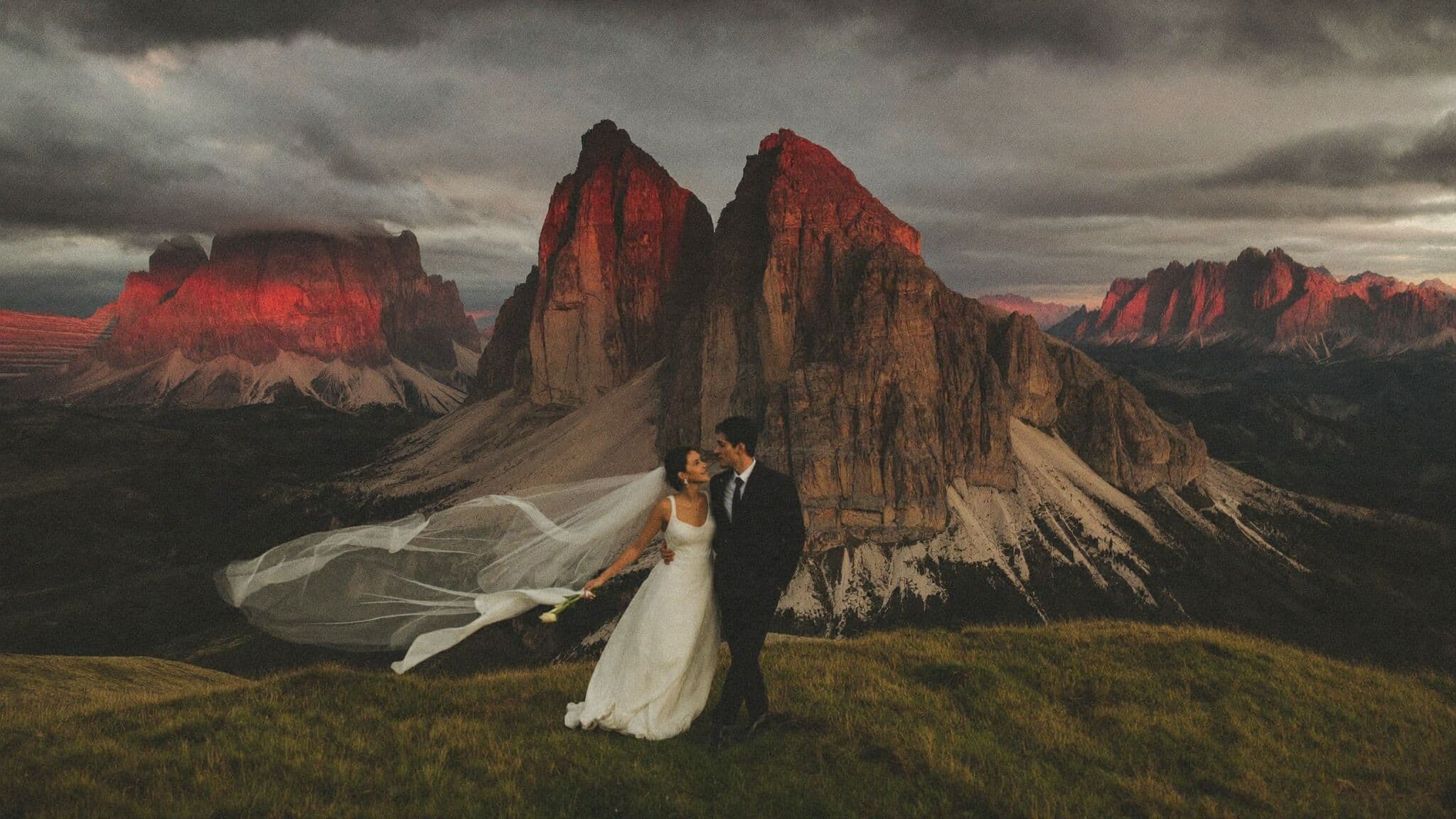
- 14:00 – Ceremony on the grassy drop-offs with the Odle spires behind you
- 16:30 – Descend and drive toward Passo Giau for the last light
- 19:00 – Rifugio dinner, toasts and enrosadira turning the walls pink
Costs and what we handle
Our Dolomites packages start at $5,000 for 8 hours with travel included, with two-day itineraries from $8,500 pairing a sunrise summit with a second valley, and multi-day trips with a rifugio overnight up to $12,000. On top of that, budget flights to Venice, Innsbruck or Munich, a rental car, four nights in the Val Gardena or Cortina area, a celebrant, hair and makeup, and the access bookings, tolls and cable car tickets, which are small but numerous. Most couples land between $9,000 and $15,000 all-in. We handle the reservations, the timing and the honest advice about what is walkable in a dress; you handle the vows.
Quick answers
Can foreigners legally get married in the Dolomites?
Yes, but it is genuine bureaucracy: a Nulla Osta from your consulate, translated and apostilled documents, and a civil ceremony in a town hall or approved venue rather than on a trail. Most couples sign legal paperwork at home and hold a symbolic ceremony in the mountains, which has no restrictions at all.
Do we need a permit to elope in the Dolomites?
There is no ceremony permit for a symbolic elopement on public trails. What you need are the practical bookings: the Tre Cime toll road reservation, timed summer entry for Lago di Braies, cable car schedules and rifugio reservations. Drone rules are strict in the protected areas. We handle all of it.
When do the larches turn gold in the Dolomites?
Mid to late October, typically peaking in the third and fourth weeks, with a window of about three weeks. Some cable cars and rifugi close from mid October, so larch plans lean on road-accessed spots like Passo Giau and the Tre Cime area, which still deliver the full show.
How much hiking does a Dolomites elopement involve?
As little or as much as you want. Seceda, Passo Giau and Lago di Braies are ten minutes or less from transport, Tre Cime viewpoints run 30 to 60 minutes on good trails, and Cadini is short but exposed. We match locations to your comfort and quote real walking times, not optimistic ones.
Keep reading
Begin the enquiry
Tell us where the map is pulling you
Enquiry-only packages from $5,000 for eight hours to $12,000 for a multi-day expedition, travel included. We answer every enquiry personally within 48 hours.